In ITER and in a fusion power plant the alpha particles generated by the fusion reactions will be the main heating source to keep the plasma at high temperature. The alpha heating takes place in the plasma core. The heat generated in this way is transported via conduction and convection towards the periphery of the plasma, it crosses the plasma boundary (the so-called magnetic separatrix) and flows along the magnetic field in a narrow layer (the Scrape-Off Layer or SOL that is a few millimeter wide) down to the divertor, a smaller chamber with actively cooled plasma facing components, where it is eventually extracted.
The problem is that the SOL width is so small and the power generated by fusion reaction so large that the heat flux can achieve values of 60MW/m2, of the same order as the heat flux at the surface of the Sun. At the moment, the divertor components can withstand fluxes on 10MW/m2 in stationary conditions and up to 20MW/m2 for limited amount of time.
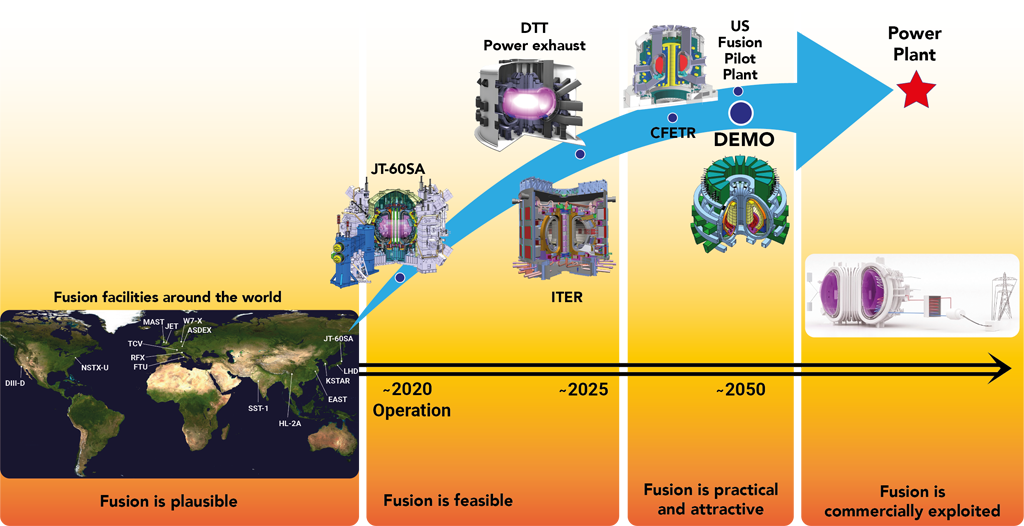
The goal of DTT is to demonstrate innovative solutions for the divertor based either on advanced magnetic configurations or new materials such as liquid metals. Advanced magnetic configurations can spread the heat on a larger surface, so decreasing the local heat flux and help in achieving detached divertor conditions. Liquid metals are not prone to the problems associated with localized melting when solid materials are used.
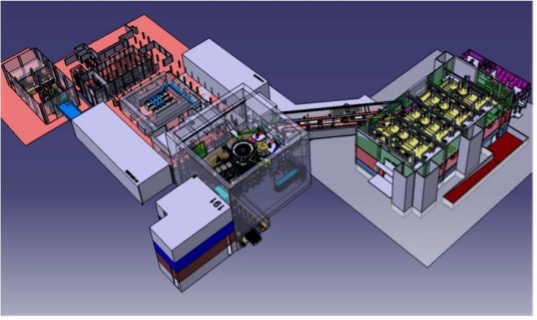
For these reasons DTT has been designed in a flexible way to accommodate different configurations as shown in the figure below.